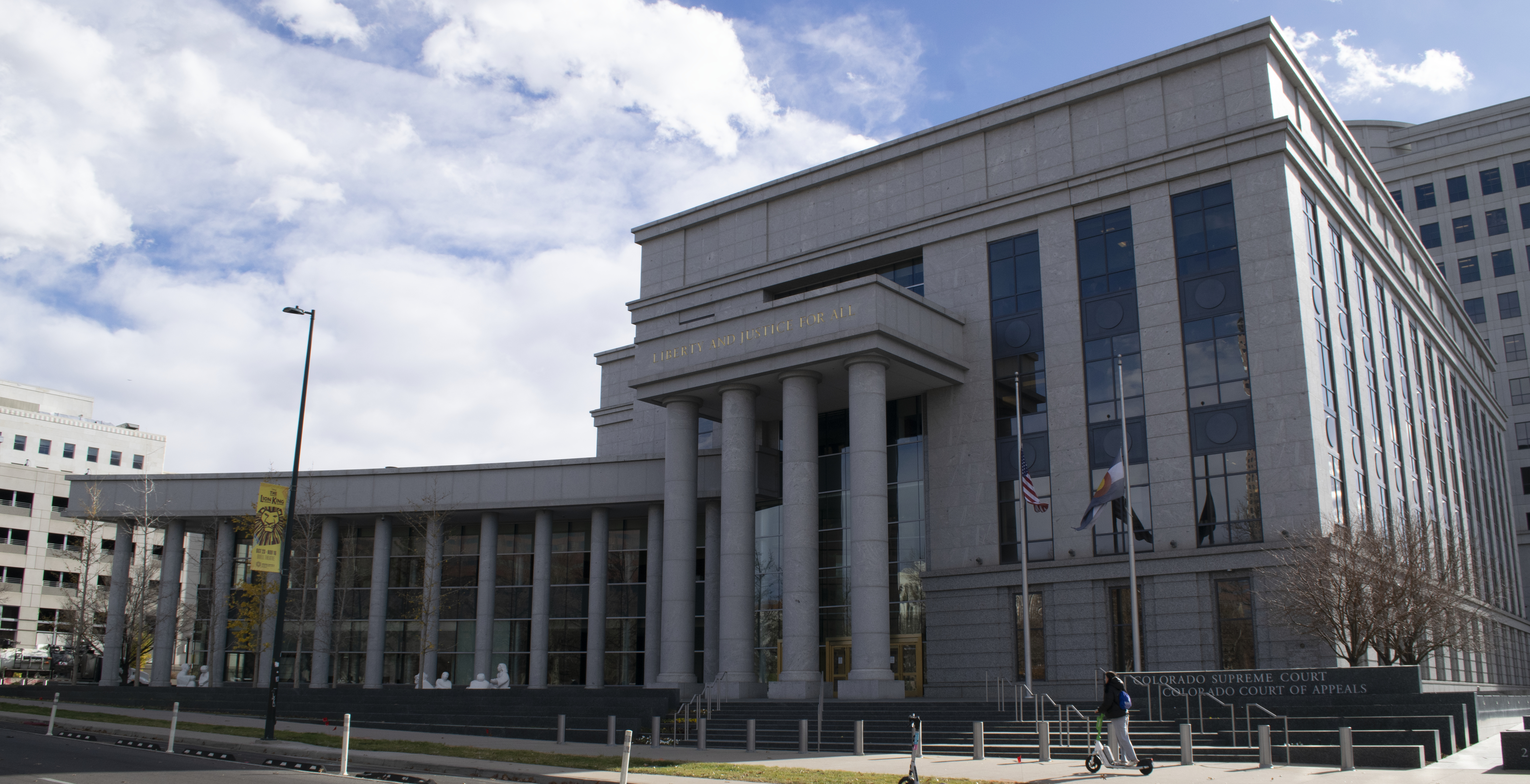
Colorado's graduated income tax measure survived a court challenge on Oct. 21, but a pending Colorado Supreme Court appeal could still determine whether votes on Amendment 87 count.
Denver District Court Judge Heidi L. Kutcher rejected a lawsuit that sought to invalidate thousands of petition signatures and remove the measure from ballots already in voters' hands, Colorado Newsline first reported. The plaintiff's attorneys appealed to the Colorado Supreme Court the next day.
A ruling from the Supreme Court is expected before Election Day on Tuesday, Nov. 3, according to Suzanne Karrer, chief communications officer for the State Court Administrator's Office, as CPR News reported.
What the lawsuit alleged
Michael A. Hancock, a conservative activist from Arapahoe County represented by attorneys from Brownstein Hyatt Farber Schreck, LLP, sued Amendment 87 proponents and Secretary of State Jena Griswold on Sept. 16. He alleged that 69 petition circulators lacked proper registration or training certificates required by the secretary of state's rules.
In her 18-page ruling, Kutcher found that 66 of those circulators were indeed not properly registered. But she concluded the violation was not serious enough to throw out the signatures they collected. The registration form in question served "primarily" as "an additional data gathering tool," not a fraud-prevention measure, according to testimony from secretary of state's office employees cited in the ruling.
Kutcher wrote that invalidating otherwise valid signatures over the paperwork issue "would violate the supremacy of the constitutional provision for initiatives."
Jason R. Dunn, attorney for Hancock, told CPR News his team disagreed with the ruling and planned to appeal, saying, "This decision was based largely on the testimony of a single witness from the Secretary of State's office."
What Amendment 87 would do
The measure would replace Colorado's flat 4.4% state income tax with six graduated brackets, according to the Colorado Sun's voter guide. Taxes would drop to 4.2% or less on the first $100,000 of taxable income. Rates would rise on income above $500,000, reaching a top marginal rate of 8.4% on income above $1 million.
The Colorado Sun reported that about 97% of the state's 3 million taxpayers would see a slight tax cut, based on Colorado Department of Revenue income data. Fewer than 100,000 households would pay more.
A household earning $75,000 in taxable income would save about $275 a year, while a household at $150,000 would save $325, the Colorado Sun reported. A family making $550,000 would pay an additional $1,175.
The measure needs only a simple majority to pass because it deletes a constitutional requirement rather than adding new language. Revenue, projected at roughly $2 billion for the first year, could only be spent on K-12 education, pre-K, healthcare and childcare.
Conservatives and business groups oppose the measure. Michael Smith, state director of the National Federation of Independent Business, said in a statement that Colorado "is already one of the most expensive states in the country." Gov. Jared Polis, a Democrat, has also called the proposal "absolutely devastating" to the state's economy, the Colorado Sun reported.
A competing ballot measure, Proposition 136, would cap state income taxes at the current 4.4% rate. Both measures would need to pass, and Proposition 136 would need more votes, for that cap to take effect.
How to vote
Ballots must be in the hands of the county clerk by 7 p.m. on Nov. 3, according to the Colorado Secretary of State's Office, as CBS News Colorado reported. Postmarks do not count. Voters can drop ballots at designated drop boxes or vote in person at a voter service and polling center through Election Day.